Medical Records for the 21st Century
The problem:
Having the patient history is vital for the physician to determine so called "base line".
As technology and diagnostics tool evolve, it is clear that the mechanism of transferring records of patient has not kept up.
Take ophthalmology records for example, when a patient moves from one physician to the other records get sent by fax if any.
This is very illogical since now we have spent so much money and effort to obtain colored high resolution tomographic images,
optical nerve thickness, OCT images and FOV charts, etc.
Then we use 1950 fax technology that was meant for text documents only to transmit the records.
By doing so, the records lose so much of their fidelity and become almost useless to the new physician.
The "Temp" Solution:
Till there is a universal method that guarantees the integrity of the record transfer,
there is no alternative to the patients who know how and care about their health but to maintain their own record.
The issue is that getting the right records from physician office is like pulling teeth, which should not be.
Also convincing the new physician to use the old record is like asking them to land a man on the moon again.
You would think they would be happy and excited to have high fidelity older records that help them establish baseline and assess progression.
In many cases doctors and technicians claimed the impossiblities of getting records out of and in the "system".
This claim can be easily debunked by a quick call to technical support of the manufacturer of the test machine being used.
Take NFRL measurements for example.
If they are done on a Heidelberg Engineering machine, the patient can be given what is called E2E file.
The file has all the digital records and can be saved on the new physician machine,
assuming they use Heidelberg Engineering and it will add the new records to the old one.
Not just that, it has the ability to create statistical base line to improve measurements such as FOV.
But that part is never explained to the patient.
It is a pity since the goal is to save the patient's eyes. Having the right record is essential in accomblishing that goal.
It could be lack of knowledge of the product, but I am sure that these capability were explained to the doctors by the manufacturers as part of the sales pitch.
Let us say the records do not come from the same machines. There is still a way of utilizing the history of measurements if they were digitized.
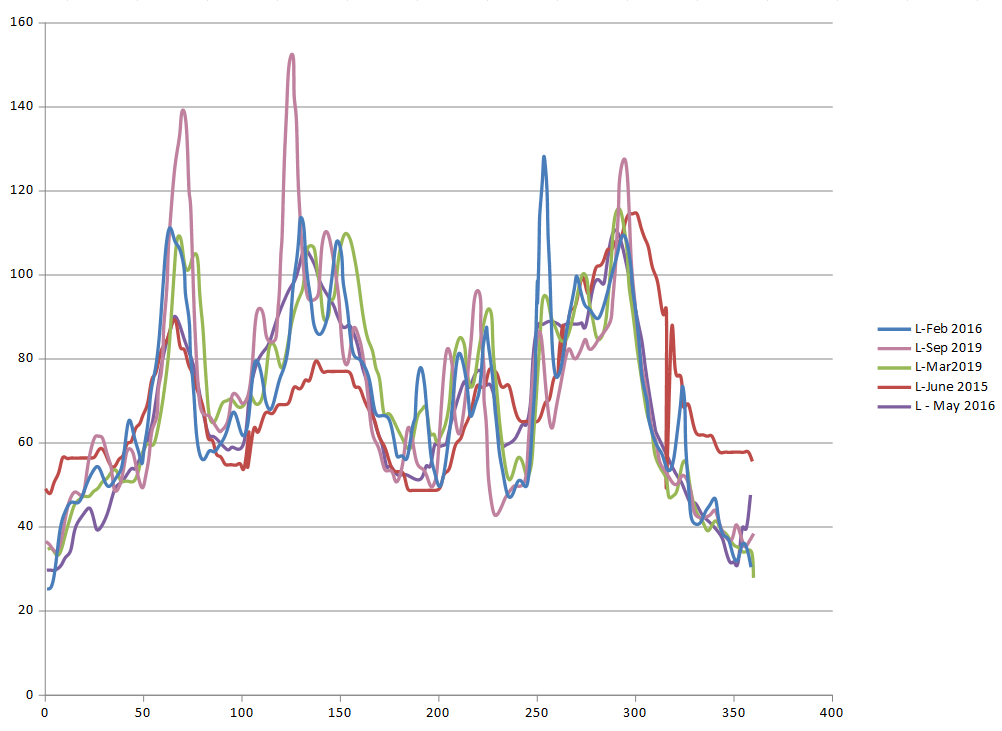
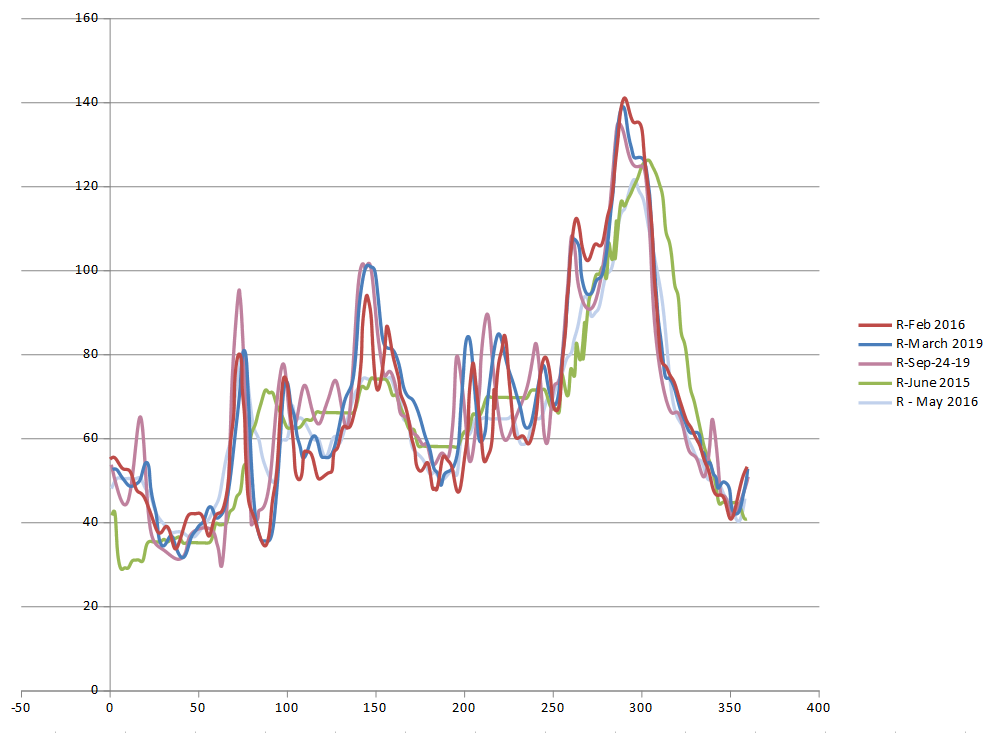
Of course that is not as optimal solution as if they were. In the figures below there is 4 curves of RNFL of both eyes of a patient.
These were actually digitized from hard copy pdf records obtained from the patient physician.
The data has resolution issues, perhaps related to the variation in machines being used.
Clearly the optical nerve thickness is below normal limits in several places.
However the thinness of the nerve is consistent and not changing with time.
This deviation from norm might be the patient's baseline.
And these findings might greatly impact the approach the doctor needs to take in the treatment.
Where is the opportunity?
Is there a way of creating software that takes all the digital records from all doctors (this has to be done in collaboration with the manufacturers) and main stream them to a universal format that is agnostic to the machine/manufacturer. That way the patient records can be maintain the history can be preserved. In this case I am particularly talking about ophthalmology records since there is a semi monopoly between the two largest machine makers, Heidelberg Engineering and Zeiss.
Is there an opportunity to create a patient owned platform where patient has his records on his phone or pc and can share them or part of them with his physicians as needed. The general consensus is that we need to digitize records but more importantly we need to figure out who own them and who saves them and where. Who is better than the patient to guard his/her health?
Could there be further opportunity in multiple fields, for example being able to tell if patients bone density is being lost based on the history of multiple x-rays of different part of the body over the years? So as patient add more record to his file, there will be warning signs raised or flags for things to watch out for and check.
Could a sudden blurry vision and health optical neve and optically healthy eyes predict a neurological problem in the brain for example.
These are just few examples. There is no shortage of possibilities if we are able to "Universalize", digitize and store records in an innovative way to help physicians and patients.
This will save a lot of eyes and lives.